|
The State of Training
Ministries in Latin America
By Rod and Sherry Boyd (Feb. 2011)
Printable version of article in pdf
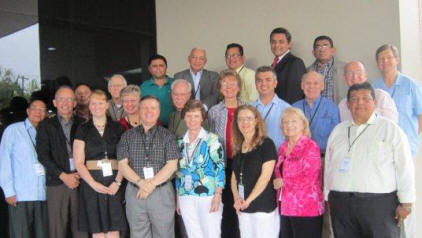 We
just ended the 2011 Educational Leaders Dialogue here in
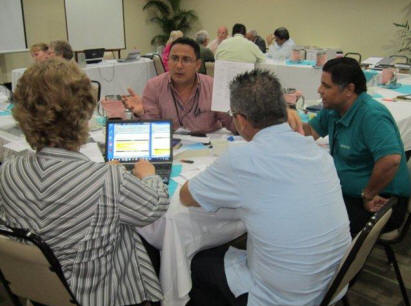
Panama City, hosting 27 leaders from 11 countries. The Resource and Advisory
Center for Bible Schools conducts this event in the odd years while the
Summits are conducted in the even years. We invite a smaller, select group
to the Dialogue on purpose. We want to maximize the participation of our key
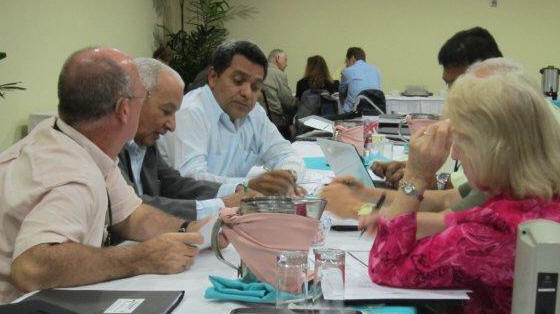
leaders. The Dialogue includes receiving country and ministry reports,
selection of areas in need of attention and small group work to develop
solutions and actions plans. We finish our time working through pending and
new items that include planning the Summits for the next year. We
just ended the 2011 Educational Leaders Dialogue here in
Panama City, hosting 27 leaders from 11 countries. The Resource and Advisory
Center for Bible Schools conducts this event in the odd years while the
Summits are conducted in the even years. We invite a smaller, select group
to the Dialogue on purpose. We want to maximize the participation of our key
leaders. The Dialogue includes receiving country and ministry reports,
selection of areas in need of attention and small group work to develop
solutions and actions plans. We finish our time working through pending and
new items that include planning the Summits for the next year.
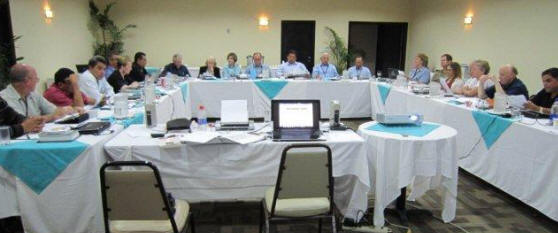
During the Dialogue we were able to present to the group
a “State of Training Ministries in Latin America” report. We had shared the
same report several weeks ago to the triennial meeting of national church
leaders for the northern 14 Spanish-speaking countries of Latin America
(CELAD). We serve as Education Director for the 20 Spanish-speaking Latin
America / Caribbean countries. Following is a condensed version of the
report that looks at factors that are working for and against ministerial
training.
Working for us…
Unifying Effect of Language.
There are 20 Latin American and Caribbean Spanish-speaking countries. This
is the single largest geographical block of countries in the world that
speak the same language. In addition, these countries share a common
heritage that contributes to cultural similarities. As these countries learn
to work together and “speak as one voice” their world influence continues to
grow, especially in the area of world missions.
Historical Commitment to Pentecostal Training and Strong
Training Infrastructure. From the very beginning, Assemblies
of God missionaries have placed strong emphasis on training from the “cradle
to the grave.” Historically, ministerial training has focused on maintaining
pure doctrine and practical preparation for ministry. This emphasis has
generally continued without government imposition. In the last two decades,
training has extended both geographically and ethnically within countries.
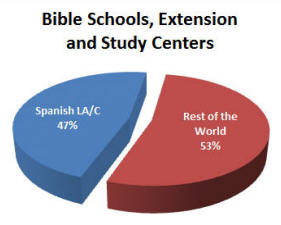 Current
statistics tell the story. In the Assemblies of God worldwide, the 19
Spanish-speaking Latin America / Caribbean countries account for: Current
statistics tell the story. In the Assemblies of God worldwide, the 19
Spanish-speaking Latin America / Caribbean countries account for:
10% - ADHERENTS
14% - CHURCHES
18% - MINISTERS
34% - MINISTERIAL STUDENTS
47% - BIBLE SCHOOLS, EXTENSIONS AND STUDY CENTERS
National Leaders Engaged and Cooperating.
Today, more than ever, our national leaders are engaged and cooperating.
They recognize the importance of working together to achieve international
educational standards. This is vital to improving the effectiveness of
ministerial training.
Diversification of Ministry. As
the church develops in Latin America, ministerial training must adapt to the
new ministry paradigms that develop. We are currently in the process of
implementing four new ministry specializations (majors) throughout the Bible
schools of Latin America: Pastoral Ministries, Missions, Christian Education
and Youth Ministries. We have also begun work on a Children’s Ministries
specialization.
Strong Missionary Movement. The
new Missions specialization goes hand in hand with the missionary awakening
that is occurring on the continent. Most of our countries have “caught the
vision” to send missionaries to other countries. Latin American missionaries
will be able to go places impossible to reach for North American
missionaries.
Strong Christian School Movement in Many
Countries. We must also recognize that the more than 300
Assemblies of God Christian Schools in Spanish-speaking the Latin America /
Caribbean region can provide the first front for training.
Working against us…
Antiquated Structures and Weak National
Coordination. Even though overall the Spanish-speaking Latin
America/ Caribbean region has a strong tradition of training, some countries
struggle with developing and maintaining visionary national leadership for
training. Some countries are utilizing leadership structures that served 20
or 30 years ago, but have become antiquated because of church and
institutional growth. Training ministries must be structured and led well if
they are to continue to be relevant.
 Lack
of Priority and Sustainable Resources. Training ministries
quite often are under-funded. Some countries do not give adequate priority
to funding these ministries. In addition, most of these countries are “third
world” or at best “second world” (developing) countries and do not have
adequate resources for training ministries. This often results in reduced
quality and out-dated methods and resources. Lack
of Priority and Sustainable Resources. Training ministries
quite often are under-funded. Some countries do not give adequate priority
to funding these ministries. In addition, most of these countries are “third
world” or at best “second world” (developing) countries and do not have
adequate resources for training ministries. This often results in reduced
quality and out-dated methods and resources.
Inability to Achieve Quality Standards.
Our training ministries struggle to achieve accepted educational and quality
standards. Text books and library books are the greatest challenge. We have
introduced new initiatives to raise the quality of teaching. We have also
emphasized the standards. However, each institution must adopt these
standards, measure how they are meeting the standards and make necessary
improvements.
Accreditation Pressure and Imposters.
There is an education frenzy in the Spanish-speaking Latin America /
Caribbean region. Rightly, parents believe that education is the path to
improving the life of their children. They want education to count and that
means accreditation. Accreditation is difficult to achieve for our Bible
schools. Meanwhile, imposters and diploma mills offer degrees with little or
no academic study.
 Years
ago Assemblies of God World Missions formalized its traditional missions
strategy, identifying the four pillars as Reaching, Training, Planting,
Touching. The emphasis on training by pioneer missionaries in the
Spanish-speaking Latin America / Caribbean region was the correct faith
response to the growth that the Holy Spirit would bring to this continent.
Training continues to sustain it by preparing for the thousands of new
churches that will be opened in unreached communities, both in Latin America
and throughout the world. We are committed to building upon our strengths
and correcting deficiencies for God has called us to raise up Christian
leaders in Latin America. Years
ago Assemblies of God World Missions formalized its traditional missions
strategy, identifying the four pillars as Reaching, Training, Planting,
Touching. The emphasis on training by pioneer missionaries in the
Spanish-speaking Latin America / Caribbean region was the correct faith
response to the growth that the Holy Spirit would bring to this continent.
Training continues to sustain it by preparing for the thousands of new
churches that will be opened in unreached communities, both in Latin America
and throughout the world. We are committed to building upon our strengths
and correcting deficiencies for God has called us to raise up Christian
leaders in Latin America.
|